Why Sporty & Rich's "copying" strategy works
Read Time
Category
Writer
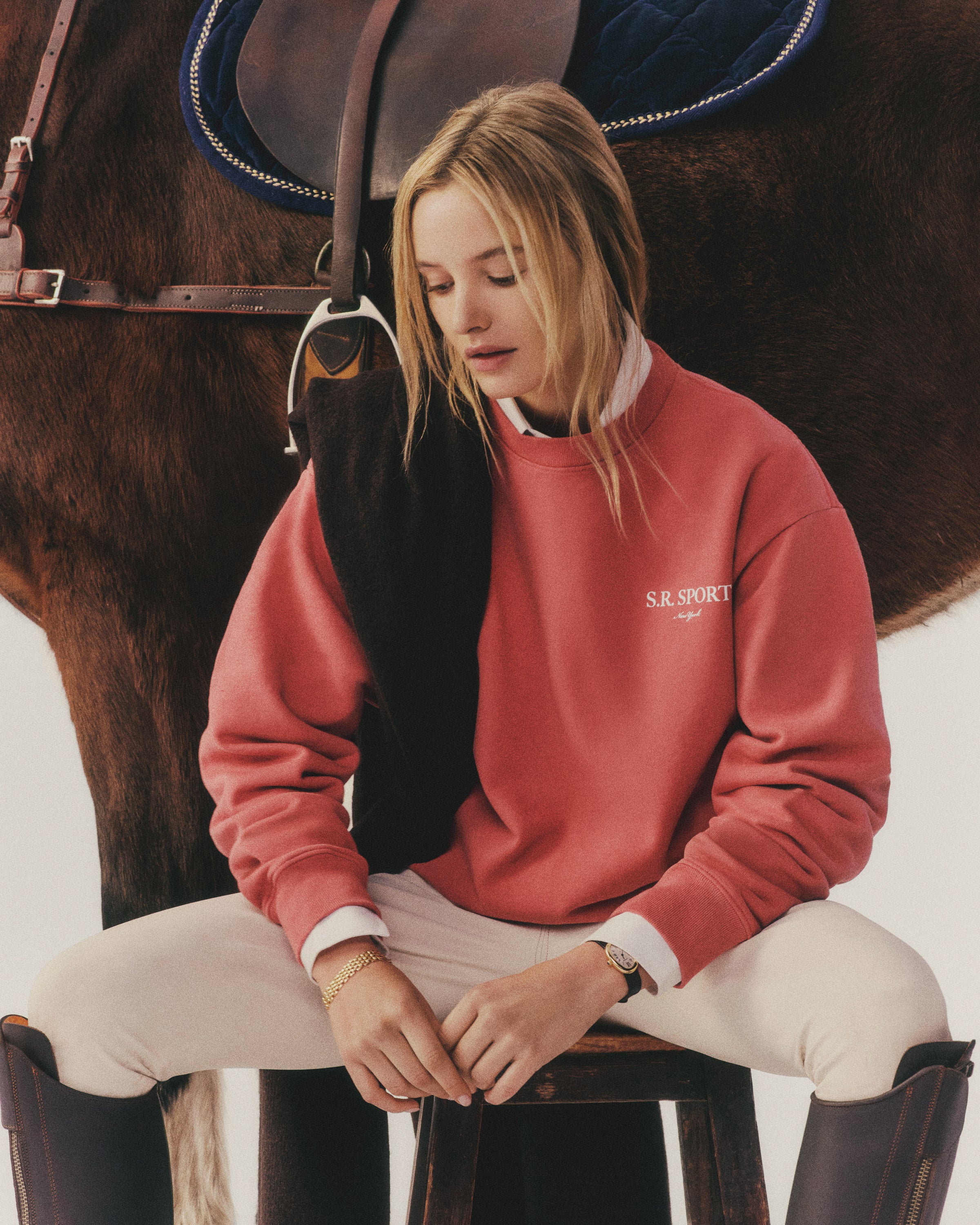
Emily Oberg and her brand Sporty & Rich seem to exist in a never cooling pot of hot water. Oberg has been ‘canceled’ three times apparently according to various chats scattered around the internet and Sporty & Rich is always under fire on the common charges that she copies existing designs and graphics. The Racquet Club graphic. The wellness logos. The old Ralph‑meets‑Esprit moodboard aesthetic that’s been spun into a multi-million-dollar lifestyle business.
It’s easy to critique. Because yes, some of the references aren’t subtle.
The Racquet Club logo is nearly identical to the defunct NYHRC one. The serif fonts, the vintage tennis visuals, the not-so-subtle nods to Dior Sport, Esprit, and 90s Ralph all feel far too familiar.
James Harris, cohost of Throwing Fits and Oberg’s former colleague at Complex, responded directly to these accusations saying…
“Anyone who criticizes Sporty & Rich’s logos and graphics don’t know what streetwear is. It’s precisely what this subculture was rooted in.”
And to be fair, he’s not wrong. Fashion (especially streetwear) has always thrived on appropriation, remix, and visual borrowing. Clothing constantly references itself, that’s how we get trends. Style evolves, not through total originality, but through reinterpretation.
Always has. Always will.
More known examples like Stüssy famously repurposing Chanel’s iconic advertisements for a 2019 campaign. Not to mock it, but as a lighthearted tribute to Karl Lagerfeld. Supreme built its visual identity around Barbara Kruger’s work, itself a statement on mass production and appropriation.
These, however, don’t feel like copies but reinterpretations, layered with intention.
With Sporty & Rich, the dynamic feels different. It isn’t ironic. It isn’t critique. It isn’t artful recontextualization. The brand is trying to make you want to participate in a visual world that signals status, health, and money.
There are dozens, maybe hundreds, of brands with similar country-club-esque references. But only one turned those references into a lifestyle empire. That’s where the founder’s influence becomes impossible to ignore. Emily Oberg’s aesthetic may not be original, but the execution is precise. And that’s often what matters more.
This doesn’t mean originality is irrelevant. It still matters, deeply. But in today’s market, originality isn’t always about being first. It’s about doing it better (clearly). Sporty & Rich wasn’t the first to tap into retro athletic visuals. It’s just the one that did it in a way that people wanted to buy into.
And that brings us to the only metric that matters in a business context.
It’s not who does it first but who does it last.
Or as Peter Thiel, cofounder of PayPal and Palantir, says the “First mover isn’t what’s important, it’s the last mover. You want to be the last company in a category.”
The truth is the truth as it is, not as you or I wish it to be. And the truth is: Sporty & Rich made around $30M last year.
That number doesn’t mean the criticism disappears, but the market has clearly spoken. Consumers don’t always choose what’s most original. They choose what resonates. And in this case, they chose a brand built not on invention but on presentation.
I for one love the Sporty & Rich aesthetic and the brand image they have built. Importantly, Emily was also one of the pioneers of turning a personality into a brand. I’m not a fan of the clothing itself but I think that’s irrelevant. The brands that succeed aren’t always the ones with the freshest ideas. They're often the ones with the clearest execution and the most consistent image.



Latest Articles.
© Airventory Studio
Thoughts, ideas, and perspectives on design, simplicity, and creative process.