Print on demand vs bulk inventory, costed properly: the break-even formula, the sell-through rate that kills it, and what a $9 blank really costs you.
Read Time
Category
Writer
The case for bulk is one number: the unit price falls. A $9 blank against a $12 on-demand unit looks like $3 of found margin on every shirt. It is not. Any print on demand vs bulk inventory decision puts that $3 through your sell-through rate, your setup fees and your size guess, and the $9 garment and the $12 garment are not the same shirt. Here is the arithmetic, then the garment.
Is print on demand cheaper than buying in bulk?
Per shirt bought, no. Bulk is cheaper per unit almost every time. Per shirt sold, print on demand usually wins, because a bulk order's cost divides across the units you actually sell, not the units you ordered. At 70 percent sell-through a $9 blank costs $12.86 per sold shirt, before setup, storage or freight.
The break-even formula for print on demand vs bulk inventory
Compare a bulk run's fixed costs against a per-unit saving already discounted for sell-through:
Break-even units sold = setup cost ÷ (POD price − bulk unit cost ÷ sell-through)
Take $400 of setup, with the $9 and $12 above. Airventory starts at $10.50, so substitute your own quote. Sell every unit and bulk breaks even at 134 shirts. Sell 90 percent and break-even moves to 200 sold, which means buying 222. Sell 80 percent and you need 533 sold from 667 bought. Below roughly 75 percent the run never breaks even at any size, because $9 divided by 0.75 is $12 and the saving is gone before the setup fee is counted.
What a $9 blank actually is
Part of that saving is not a saving. It is a downgrade. Wholesale blanks priced for print volume, from Bella+Canvas to Gildan to Next Level, are knitted light and open so they run cheap and print flat. You feel it in the drape, in a collar rib that stops recovering after a few washes, in side seams that twist, and in fit and shade that drift between lots, so your reorder does not match your first run. That garment is shaped by manufacturing convenience. Our own blanks run 250 to 450gsm in combed cotton, reverse-engineered from 255 million data points across 36 sources and 34 products. Costing $9 against $12 as though the shirt were constant is the mistake underneath the bulk case.
What a bulk quote leaves out
The quote covers manufacturing. It says nothing about running bulk inventory once the pallets land, and these routinely exceed the saving that motivated it.
Size curve error. You guess the shape of demand before you have any. Standard curves overweight M and L; your customers may skew XL. What you get wrong becomes a permanent shelf resident.
Markdowns. Dead sizes clear at a discount that comes out of the margin the good sizes earned.
Storage and handling. Warehousing bills by pallet or bin per month, plus a pick-and-pack fee per order, for as long as the stock sits.
Double shipping. Factory to warehouse, then warehouse to customer. On-demand production ships once, to the doorstep.
Locked capital. Cash in boxes cannot buy ads, samples or the next design, usually the binding constraint on a young brand.
How the print method changes the math
Screen printing and embroidery carry minimum order quantities and charge per color and per digitized file, so a multi-color front across several garment colors multiplies fixed costs fast. The cheapest on-demand suppliers dodge those fees with a large DTF transfer: pigment and hot-melt adhesive pressed onto the fabric. Across a full front it does not breathe: it stiffens the drape, creases along fold lines and lifts at the edges, because the film cannot flex with the knit. DTF earns its place small: tagless neck and care labels, chest and sleeve hits, polyester, fleece, nylon, caps and totes. For a full front on cotton the right tool is DTG, printed in our own facilities to one specification, up to 60 x 60cm at a fixed 1200 DPI.
When does bulk actually make sense?
When one style has sold steadily long enough to give you real size distribution from your own orders, the design is a permanent line rather than a drop, the decoration is simple, and the cash you are about to immobilize is spare. No unit count flips that decision by itself, and every cost above scales with the order rather than disappearing at volume: more pallet months, more capital tied up, a bigger markdown bill if the size curve was wrong.
Can you run print on demand and bulk together?
Yes, and most established brands do. Bulk the styles you have proven and keep everything unproven on demand. Extend tail sizes on demand rather than buying 2XL and 3XL you may never move; that removes most of the size curve risk and keeps the full range on the product page.
The hybrid only works if the customer cannot tell which half is which, so garment and branding have to match exactly. Marketplace print on demand cannot hold that line. Printful, Printify and Gelato route each order to whichever third-party partner accepts it, so weight, hand feel and print density shift between orders and your tenth drop does not match your first.
The branding argument that used to favor bulk
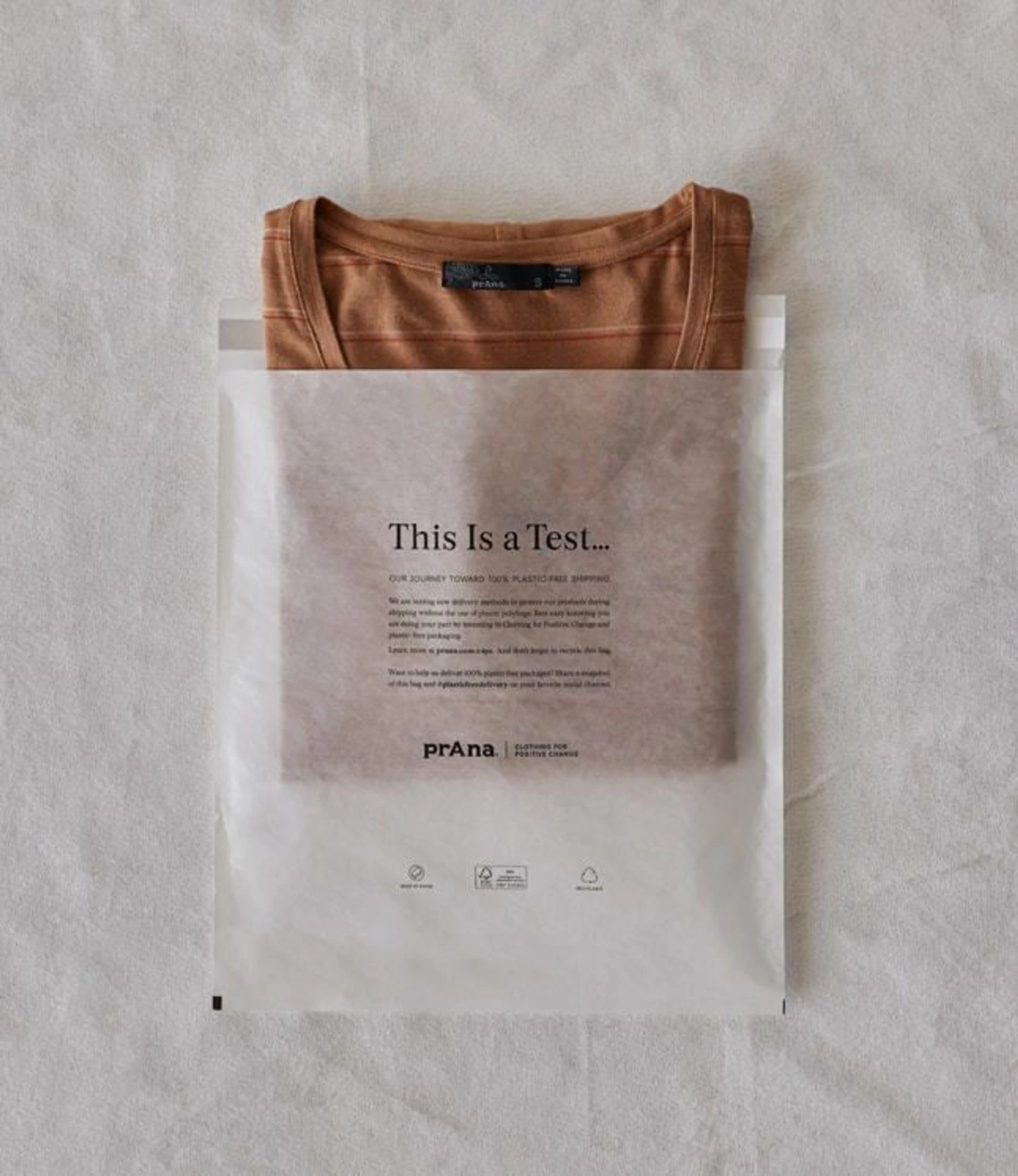
Bulk was once the only way to own the neck label, the hangtag and the box, while print on demand shipped a generic garment with somebody else's tag in it. That was a real reason to buy a thousand shirts you had not sold. We removed it. Airventory applies woven neck labels, printed tagless labels, hangtags, inserts and branded polymailers in production with zero minimums, on the same unit, as the order arrives, and nothing in the parcel carries our name. Branded packaging deserves the money you put into it; it is the cheapest quality signal a small brand has, and it no longer means a thousand pre-printed labels in a box, hostage to a design you may revise next season.
The verdict
Bulk wins on a proven style with a known size curve, simple decoration and spare cash, and only when sell-through clears the number the formula demands. Print on demand wins everywhere else: new designs, tail sizes, seasonal work, anything you are still guessing at. Run the formula before every order, on the sell-through your sales data supports. A bulk run that breaks even at 134 units and sells 90 was a setup fee, a warehouse invoice and a rack of unsold XS. And on a commodity blank, part of that margin was paid for by the garment your customer has to wear.

Latest Articles.
© Airventory Studio
Thoughts, ideas, and perspectives on design, simplicity, and creative process.